
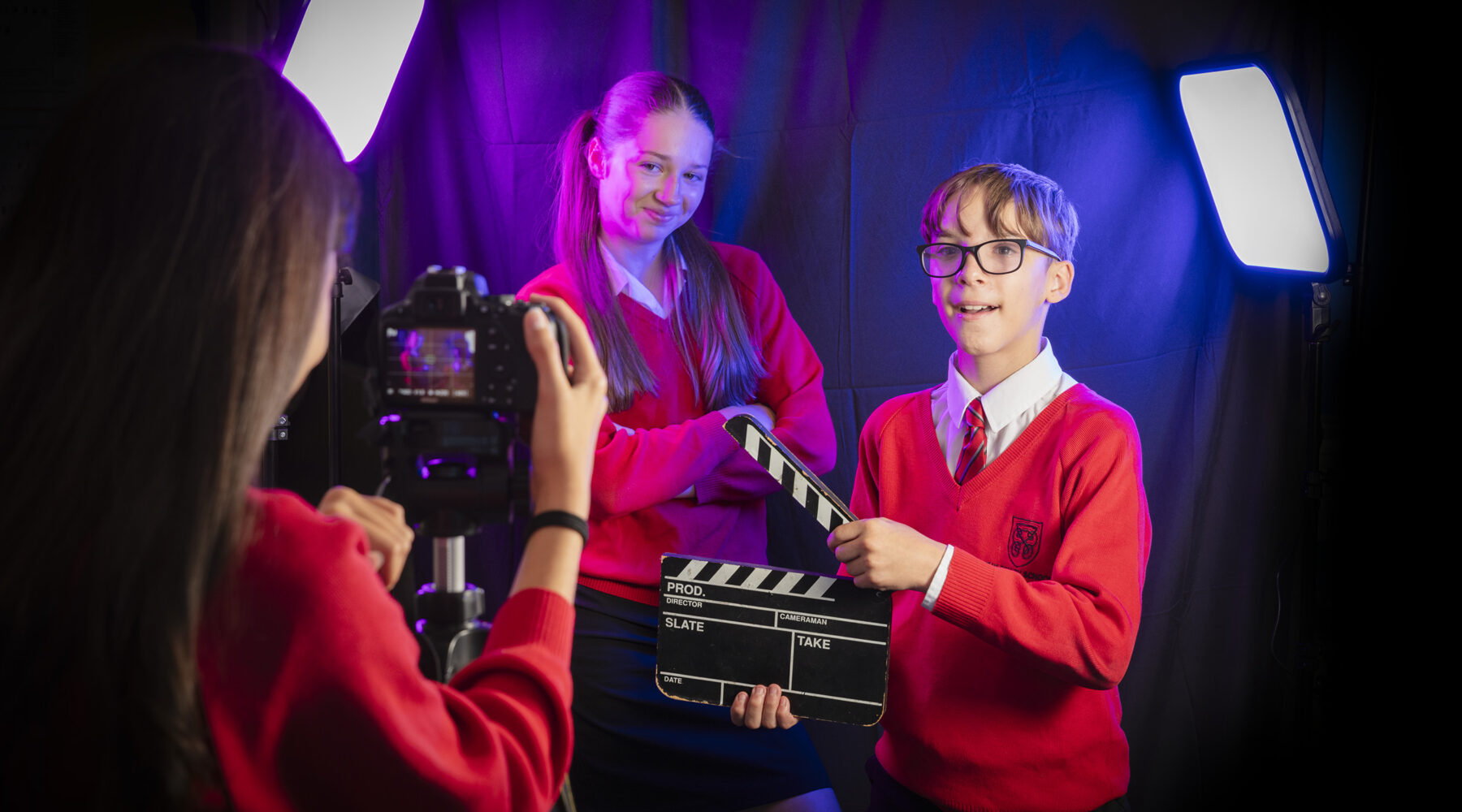
The Media, Business and Communications department offers students distinct pathways designed to help them choose their journey into the professional world, backed by enrichment opportunities, trips, and work experience with industry-leading organizations such as Bloomberg, Reuters, Sky Studios, and the Tate Modern.
Our curriculum is built around the core philosophy: Shape your story. Drive your career. Communicate the future.
Key Stage 3
In Years 7, 8, and 9, students begin their journey into Media and Business through a variety of cross-curricular subjects and enterprise initiatives. This early exposure ensures that students are systematically introduced to high-tier academic vocabulary and core industry concepts, giving them a distinct advantage and a strong foundation as they transition into GCSE study.
Our KS3 Media and Business experiences include among the others:
- Year 7: Cantina Carnitas Challenge – An enterprise and design project where students develop their initial branding, teamwork, and entrepreneurial skills.
- Year 8: One Pound Challenge – A hands-on business initiative challenging students to pitch, manage micro-finance, and maximize the return on a single pound investment.
- Year 8: The Guardian Trip – A dedicated experiential visit designed specifically to accelerate the acquisition of high-tier vocabulary, where students immerse themselves in a fast-paced broadsheet newsroom environment to see professional literacy in action.
- Year 8: English Media and Film Scheme of Learning – An academic introduction to media literacy, focusing on textual analysis, moving-image language, and critical deconstruction.
- Year 9: Computing with Creative Summer Project – A technical and creative hybrid module where students apply digital literacy, content creation, and project management skills to a real-world brief.
KS3 Photography and Film Club
Extending beyond the classroom, our popular KS3 Photography and Film Club provides an exciting extracurricular space for younger students to explore their creative passions. Meeting weekly, the club introduces students to the fundamentals of camera handling, framing, lighting, and digital editing.. This vibrant club serves as an excellent stepping stone, sparking an early interest in the media arts and preparing students for the technical and creative demands of upper-school study.
The Creative Route
OCR GCSE Media Studies
The course allows students to critically study a range of texts from a variety of media platforms. Students will begin by developing the key skills necessary to critically analyse and create media products. Study will then focus upon some of the key institutional values associated with media industries, such as film marketing, television crime drama and the developing newspaper industry.
The course features an Analysis of Representation in Media (including TV, Music, and News), Content Creation, and Visual Storytelling.
The grading structure consists of a 70% Written Exam and 30% Coursework (NEA unit), allowing students to display their own critical understanding of the concepts developed in the classroom across their Year 11 study.
Career Destinations: The Creative Route equips students with the skills required for a wide range of media professions, leading to destinations such as Media Writer, Film and Media Production, Digital Marketing, Journalism, Editor, and TV and Music Production.
Media Studies is an engaging and ever-developing subject, allowing students to gain a valuable insight into a subject area which will continue to shape the world around them.
Eduqas GCSE Film Studies
The Eduqas GCSE Film Studies course offers an engaging exploration of film as an art form, a technology, and a powerful social and cultural medium. Students will learn to analyse and interpret films using a wide range of critical and theoretical concepts.
Following the Creative Route framework, the course blends theoretical knowledge with practical execution, assessed via 70% Written Exam and 30% Coursework.
The course covers:
- Key Elements of Film: Detailed study of film language (mise-en-scène, cinematography, editing, sound) and its impact on meaning.
- Film History and Context: Examining films from various time periods, countries, and genres, understanding their social, historical, and industrial contexts.
- Creative Film Production: Practical work involves students developing skills in short film planning, production, and evaluation, allowing them to apply their theoretical knowledge creatively to visual storytelling.
This GCSE provides a strong foundation for students interested in careers in film, television, or the wider creative industries, or those who simply wish to deepen their appreciation and understanding of cinema.
A-Level Media
As a department we also offer Media Studies at A Level and this has proven to be very popular. The course is designed so that no prior knowledge of Media Studies is needed. We follow the OCR specification, students coursework makes up 30% of their final grade with the other 70% being made up of two 2-hour exams.
A Level Media Studies is an engaging and enjoyable subject which asks students to engage with the key concept that underpin the study of the media; genre, representation, audience and narrative. The course encourages students to study the media in an academic context and apply their newly gained knowledge to the process of creating their own media productions.
Our A Level in Media Studies offers a broad, coherent and rigorous course of study and has been created to ensure that all types of learners can fulfil their potential.
A-Level Film Studies
We are also pleased to offer OCR Film Studies as part of our post 16 A-Level offer. Film studies is an engaging subject which enables students to partake in an in-depth and critical study of film. The course will allow students to study a variety of texts, with particular components focussing upon Film History, Critical Approaches to Film, as well as a chance to develop and produce their own short film.
The structure of the course enables students to develop key analytical and creative skills, which culminate in two final exams totalling 70% of the final grade. Finally, the additional 30% of the grade is made up of NEA (Non Examined Assessment) in which students will create their own individual short film production.
OCR Digital Media Level 3
The Digital Media Level 3 course offers students a practical and theoretical grounding in the digital media sector. It’s designed to equip learners with the skills and knowledge needed for further study or employment in areas like digital content creation, video production, web design, and photography.
Students will develop expertise in:
- Pre-production and Planning: Understanding audience, brief analysis, legal and ethical considerations, and project planning.
- Media Production Skills: Practical application of software and techniques for creating various digital media products, such as video, audio, graphics, and interactive content.
- Post-production and Editing: Mastering techniques in editing, compositing, and finalising media projects to a professional standard.
- Media Industry Context: Exploring the structure of the media industry, career paths, and the impact of digital technology.
This course emphasizes hands-on experience and portfolio development, allowing students to build a body of work that demonstrates their competence across a range of digital media platforms.
The Finance Route
GCSE Business Studies
As a department we offer the OCR GCSE qualification in Business Studies. The course allows students to critically study a range of enterprises from small local businesses to multinational corporations. Students will begin by developing the key skills necessary to understand the core functions of running a business, including marketing, human resources, and operations. Study will then focus upon how businesses manage finance and respond to the wider economic environment.
The curriculum places a strong emphasis on strategic thinking, market analysis, and economic impact. Assessment is structured across 2 exam papers, focusing on:
- Finance
- Marketing
- Maths
Career Destinations: Studying GCSE Business opens pathways to high-profile industries, preparing students for future success in Investment Banking, Corporate Management, Financial Analysis, and Entrepreneurship.
GCSE Business is an engaging and dynamic subject, allowing students to gain a valuable insight into how businesses operate and innovate in a constantly evolving commercial world.
A-Level Business
As a department we also offer Business at A Level and this has proven to be a highly successful and popular option. The course is designed so that no prior knowledge of Business is needed. We follow the Edexcel specification, and the course is assessed through external examination.
A Level Business is an engaging and rigorous subject which asks students to engage with the key concepts that underpin commercial strategy; corporate decision-making, digital technology, international business, and leadership. The course encourages students to study corporate environments in an academic context and apply their newly gained knowledge to real-world business case studies.
Our A Level in Business offers a broad, coherent and comprehensive course of study and has been created to ensure that all types of learners can fulfil their potential in the modern corporate landscape.
A-Level Economics
As a department we are also pleased to offer Economics at A Level. The course is designed so that no prior knowledge of Economics is needed, though strong analytical and quantitative skills are beneficial. We follow the OCR specification, and the assessment is entirely examination-based, with 100% of the final grade made up of written exams.
A Level Economics is an engaging and highly intellectual subject which asks students to engage with the key concepts that underpin global markets; microeconomic pricing, macroeconomic policy, market failure, and international trade. The course encourages students to study economic theory in an academic context and apply their newly gained knowledge to pressing global issues and economic fluctuations.
Our A Level in Economics offers a broad, coherent and academically challenging course of study, ensuring that students develop the critical thinking skills necessary to understand the complex systems that shape our world.
Trips, Work Experience, and Industry Enrichment
Learning in this department extends far beyond the traditional classroom setting. We run a robust schedule of off-site visits and corporate partnerships that directly correspond to our curriculum pathways. Students exploring the Finance Route have opportunities to engage with global market leaders like Bloomberg and Reuters, gaining insight into corporate management and market analysis.
Meanwhile, those following the Creative Route immerse themselves in professional content creation and visual storytelling via targeted trips to Sky Studios and the Tate Modern. These experiences are meticulously mapped to show students how their classroom learning transitions into real-world career destinations.
Learning and Organisation
GCSE Folder Structure System
To ensure academic success and support independent study, the department implements a structured folder management system for all GCSE students. Maintaining an organized folder is a vital component of a student’s learning journey, serving as a comprehensive revision tool as they approach their final Year 11 examinations.
Formative Assessment
To ensure students remain on track throughout their GCSE journey, teachers deploy regular formative assessments within lessons. This ongoing process utilizes targeted low-stakes quizzes, structured peer-review sessions, and real-time verbal interventions to gauge understanding of complex topics. By identifying knowledge gaps immediately rather than waiting for formal endpoints, teachers provide students with actionable, immediate feedback that helps refine their technical accuracy and strengthens their recall of core curriculum frameworks.
Facilities and Internships
The Media Studio
To complement our academic pathways, the department boasts a dedicated, state-of-the-art Media Studio designed to bridge the gap between classroom theory and industry-standard practice. This professional-grade environment is equipped with high-definition cameras, green-screen backdrop technology, studio lighting, and premium multi-track audio recording equipment. Alongside the physical space, students have full access to high-performance editing suites loaded with the industry-standard software required for post-production, digital graphics, and visual storytelling. The Media Studio functions as a creative incubator, allowing students to act as directors, editors, and producers as they craft their NEA coursework portfolios and technical projects.
Media and Business Internship & Hitchin Community Work Experience
At The Priory School, Hitchin (TPSH) we pride ourselves on embedding our students deeply within the local landscape. Through our exclusive Media and Business Internship program, students gain invaluable, front-line professional exposure right here in the Hitchin community. We partner with celebrated local independent businesses and cultural hubs to offer high-quality work experience placements.
So far our students have had the opportunity to manage digital marketing and curation at Next Page Books, drive community engagement campaigns with We Love Hitchin, dive into entertainment operations and event promotion at Broadway Cinema, and analyze commercial operations and consumer trends with Peckers Hitchin. This robust local network underscores TPSH’s commitment to driving student careers, fostering community entrepreneurship, and giving our learners a true competitive edge.
Staff
- Jose Sala Diaz – Head of Department
- Neil Parsons – Teacher of Media & Film
- Benjamin Mensah – Teacher of Computing and Digital Media
- Oan Shah – Teacher of Business and Economics
- Cameron Omar – Teacher of Business
- Nicola Moran – Teacher of Business