
Curriculum
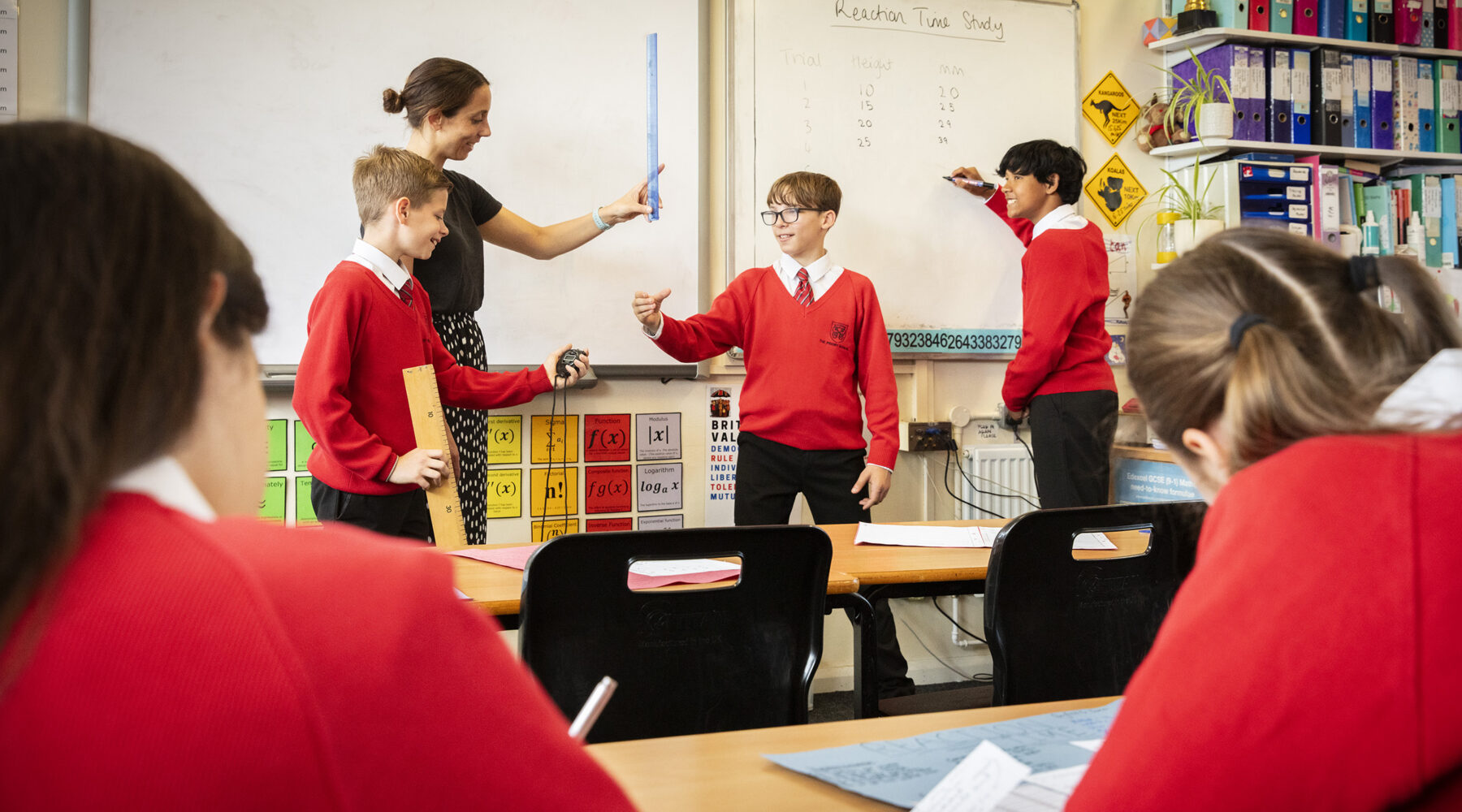
The Mathematics Department is committed to providing a stimulating and intellectually rigorous environment. We leverage a diverse range of pedagogical styles to strive for every student to develop mastery of the subject, regardless of their starting point. Our curriculum provides a coherent journey so that students don’t just learn procedures, but understand the underlying principles of mathematics, giving them the tools to navigate the world around them.
Each mathematics lesson is engineered to be high-challenge and ensures accessibility for all through expert teacher scaffolding. While teachers bring their own unique flair and expertise to the classroom, every lesson is underpinned by a consistent, high-impact structure of retrieval practice, explicit modelling, variation of examples, discursive learning, formative assessment and deliberate independent practice. We utilise a high-frequency assessment model, including low stake “snapshots” and mini-whiteboard work, to ensure responsive teaching and the immediate rectification of misconceptions.
At the heart of our department is a spiralling curriculum that prioritises the interconnectedness of mathematical concepts. We do not teach topics in isolation; instead, we interweave to ensure that previously mastered concepts and skills are constantly revisited and applied to increasingly sophisticated contexts. This cognitive approach ensures that knowledge is encoded into long-term memory, allowing students to deepen their conceptual understanding over time.
We believe every student is entitled to an ambitious, knowledge-rich curriculum that ignites intellectual curiosity and develops fluency, reasoning and resilient problem solvers.
KS3 (Years 7, 8 & 9)
Students follow the Sparx Maths Curriculum at KS3, a meticulously sequenced curriculum that builds on prior primary attainment. This is a spiralled curriculum, meaning we circle back to key topics regularly. By building on what students already know, we help them strengthen their memory and learn how to use their mathematical skills in new, more challenging ways. This is consolidated further through the use of weekly Sparx homework.
Students begin Year 7 being taught in sets according to their KS2 levels, CATS data and maths baseline assessment. Set changes can occur at any time throughout Key Stage 3, but usually take place after each summative assessment point.
KS4 (Years 10 & 11)
At Key Stage 4, we follow the Edexcel 1MA1 specification, which covers topics from the five core strands: Number, Algebra, Ratio & Proportion, Geometry, and Statistics & Probability. Whilst these are all topics honed during Key Stage 3, they are now elevated with a greater focus on developing procedural fluency, logical reasoning and strategic problem-solving. As with Key Stage 3, our curriculum interweaves topics, frequently revisiting them to ensure students can synthesise different areas of maths. This constant reinforcement builds academic stamina and resilience.
Success at Key Stage 4 requires more than just subject knowledge; it requires accuracy and exam craft. We explicitly teach students how to navigate the nuances of the GCSE papers, including understanding command words, developing clear and logical workings as well as proactively identifying common mistakes and misconceptions to ensure accuracy under pressure.
Students are taught in sets based on their progress and attainment at Key Stage 3. The evidence from assessments and GCSE targets are used to determine the tier of study (Higher or Foundation) that the students will commence studying in Year 10.
KS5
In Key Stage 5, students are introduced to calculus and more complex trigonometric and geometrical problems. They will develop further their ability to communicate mathematically using algebra. Students will learn how to set up mathematical models and use them to assess solutions to problems and make predictions. A-level mathematics is a much valued qualification which provides support in the learning of a variety of other subjects.
Students follow the Edexcel specifications for A-level Maths and Further Maths.
| A Level Maths | Topics | Duration | Weighting |
| Paper 1 and Paper 2 | Pure
Proof, Algebra and functions, Coordinate geometry in the (x, y) plane, Sequences and series, Trigonometry, Exponentials and logarithms, Differentiation, Integration, Numerical methods, Vectors |
Each Paper is 2 Hours | 33.3% each |
| Paper 3 | Section A: Statistics
Statistical sampling, Data presentation and interpretation, Probability, Statistical distributions, Statistical hypothesis testing Section B: Mechanics Quantities and units in mechanics, Kinematics, Forces and Newton’s laws, Moments |
2 Hours | 33.3% |
Further Mathematics is designed for students with an enthusiasm for Maths, many of whom will go on to degrees in Mathematics, Engineering, the Sciences or Economics. The qualification is both deeper and broader than ‘A’ level Mathematics and it can only be studied as an addition to ‘A’ level Mathematics. We offer both AS level further maths taught over 1 year in year 12 and A level maths taught over 2 years of study.
| AS Level Further Maths | Topics | Duration | Weighting |
| Paper 1 | Pure
Proof, Complex numbers, Matrices, Further algebra and functions, Further calculus, |
2 hours | 62.5% |
| Paper 2
Part A |
Decision 1
Algorithms, Graph theory, Linear Programming |
1 hour 15 mins
|
37.5%
|
| Paper 2
Part B |
Decision 2
Game Theory, Allocations, Network Flows |
| A Level Further Maths | Topics | Duration | Weighting |
| Paper 1
and Paper 2 |
Pure
Proof, Complex numbers, Matrices, Further algebra and functions, Further calculus, Further vectors, Polar coordinates, Hyperbolic functions, Differential equations |
Each Paper is 90 mins |
25% each |
| Paper 3 | Decision 1
Algorithms, Graph theory, Critical Path Analysis, Linear Programming |
90 mins |
25% |
| Paper 4 | Decision 2
Game Theory, Network Flows, Allocations, Dynamic Programming |
90 mins |
25% |
Core Mathematics (Mathematical Studies)
This Level 3 qualification was introduced for first teaching in September 2014. It is distinct from A Level mathematics and it should fit alongside a student’s main 16-18 programme. Students study this in Year 12, taking two exams which are equally weighted in the summer of Year 12.
Why study Core Maths?
The ‘Core Maths’ qualification is designed to better prepare students for the mathematical demands of study, employment and life. It will develop students’ ability to think mathematically, logically and analytically and will build skills in applying maths to new problems and issues. The Core Maths initiative is a major part of the government’s plan to increase participation and raise standards in mathematics. The course has been developed with employers, universities and professional bodies as valuable preparation for university study and employment. Core Maths will maintain and develop students’ real-life mathematical skills.
The study is not purely theoretical or abstract; it can be applied on a day-to-day basis in work, study or life and includes a financial mathematics element. Studying Core Maths will also support other A-Level subjects – in particular with science, geography, business studies, psychology and economics.
We follow the AQA 2A specification which builds on the knowledge, understanding and skills acquired studying GCSE mathematics with a sharper focus on problem solving skills by considering and tackling mathematics in meaningful contexts. The core areas studied are financial applications of mathematics, critical analysis of data and estimation as well as the optional units including further statistical techniques.
Enrichment
Annual Events
- Senior Maths Challenge (Years 12 & 13)
- Mathematical Olympiad for Girls (Y11, 12, 13)
- Intermediate Maths Challenge (Set 1 students from Years 9, 10 & 11)
- Junior Maths Challenge (Set 1 students from Years 7 & 8)
- Hertfordshire County Team Maths Challenges for Years 7 & 8
Careers
Good qualifications and an interest in Mathematics can open doorways into many interesting and valued job opportunities:
-
“Mathematicians at work” – http://www.mathscareers.org.uk/16-19/career_profiles.cfm
-
“Maths career choices” – http://www.ehow.com/about_4728423_math-science-career-choices.html#page=0
-
“Careers with Maths” – http://plus.maths.org/content/Career
Staff
The Mathematics Department consists of ten committed specialists whose aim is for all students to enjoy the subject and achieve their full potential.
- Mrs Freya Parsons – Head of Department
- Ms Sarah Jones – Joint 2nd in Department
- Mr Alex Greenwood – Joint 2nd in Department; KS5 Mathematics
- Miss Chloe Hutton – 3rd in Department
- Mr Atof Blaal – Teacher of Mathematics
- Mrs Helen Hardwick – Teacher of Mathematics
- Mrs Fiona Rosler – Assistant Headteacher Teaching & Learning
- Miss Sam Walker – Teacher of Mathematics; Head of Year 8
- Mrs Amita Patel – Teacher of Mathematics
- Mrs Sandhya Pagilla – Teacher of Mathematics
- Mrs Tracy Geldman – Intervention Tutor
Links
- EDEXCEL (Our Exam Board) – http://qualifications.pearson.com/en/qualifications/edexcel-gcses/mathematics-2015.html
- Mathsgenie – www.mathsgenie.co.uk
- Corbett maths – https://corbettmaths.com/
- Sparx maths – https://sparxmaths.com/